
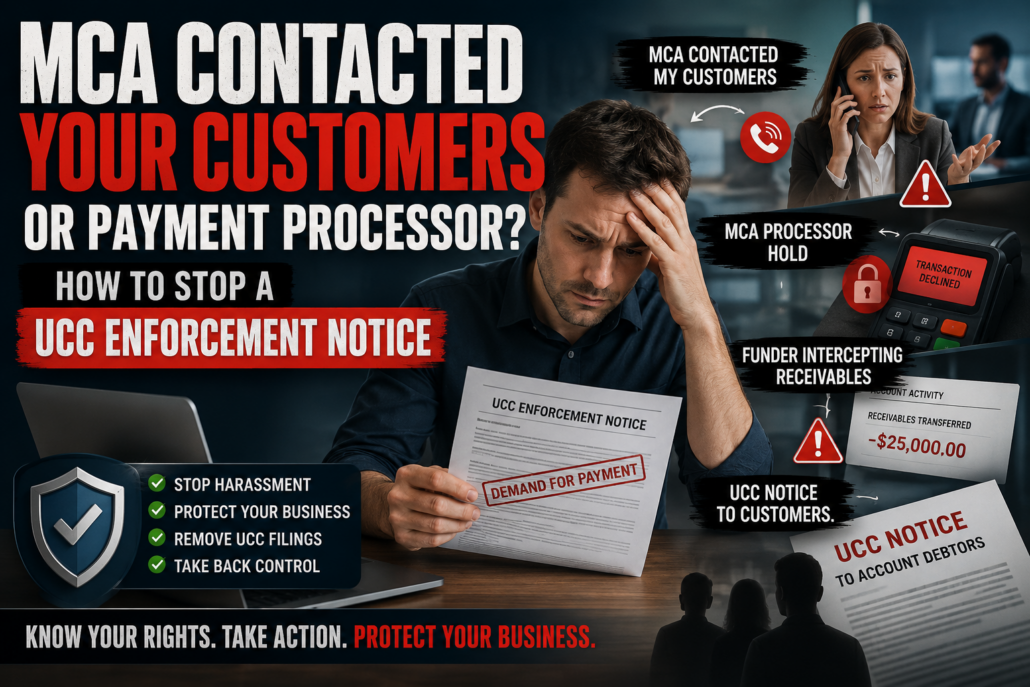
MCA Contacted Your Customers or Payment Processor? How to Stop a UCC Enforcement Notice
Your funder is intercepting your receivables at the source. Here’s how to stop it — and what the next 24 hours should look like.
A customer just forwarded you a letter they received from your merchant cash advance company — instructing them to send their payments to the funder instead of to you. Or your payment processor called to say a hold has been placed on your account and deposits are being redirected. The money your business is owed is now being pulled away before it ever reaches you, and the MCA company is demanding immediate payment. This is a UCC enforcement notice in action — and it can choke off your cash flow faster than almost any other collection tactic.
| ⚠ Emergency — act today If your funder is intercepting receivables or has notified your customers or processor, every day of delay costs you revenue you may never recover. Call (888) 201-0441 now to be connected with an MCA defense attorney who can move to stop the interception. CredibleLaw is a national referral network, not a law firm. |
| Quick answer An MCA company can send a UCC notification telling your customers or payment processor to pay the funder directly, based on a security interest in your receivables. To stop it, obtain the notice and your agreement, have an attorney check whether the lien or its enforcement is defective, and dispute it immediately — before more revenue is diverted. |
What’s Actually Happening: The UCC Notification to Account Debtors
When you signed your merchant cash advance agreement, you almost certainly granted the funder a security interest in your receivables, perfected by a UCC-1 financing statement. That lien is the legal basis for what’s happening now. Under the UCC, a secured party claiming the right to your receivables can send a notification to account debtors — your customers — directing them to pay the funder instead of you. The same leverage is used to pressure payment processors into placing a hold and rerouting your deposits.
The effect is immediate and brutal: your incoming revenue is intercepted at the source. But “immediate” does not mean “unstoppable.” These notifications depend on a valid, enforceable lien and proper procedure — and both are frequently open to challenge. Whether the funder overstated the balance, failed to honor reconciliation, is enforcing a lien tied to a disguised usurious loan, or simply overreached, an attorney can move quickly to dispute the notice and cut off the interception.
What to Do in the Next 24 Hours
Speed matters more here than in almost any other MCA scenario, because every business day of interception is revenue gone. Work through these in order.
- Get a copy of the notice. Ask the customer or processor to forward the exact letter the funder sent, including any UCC or account numbers referenced.
- Pull your MCA agreement and the UCC-1 filing. You’ll need the security-interest language and the financing statement that perfected it.
- Document which receivables have been diverted. Note every customer contacted and every payment rerouted or held — this frames both the urgency and the damages.
- Contact an MCA defense attorney immediately. Interception cases are time-sensitive; counsel can often act within days to dispute the notice and demand it be withdrawn.
- Notify affected customers carefully — through counsel. Your customers are caught in the middle. How you communicate matters, and an attorney can help protect those relationships while the dispute is resolved.
- Preserve every communication. Save the funder’s letters, processor notices, and any threats — they may support a challenge to the enforcement or a counterclaim.
| Don’t wait for the next deposit cycle The longer receivables are diverted, the harder your business is to keep running. An MCA defense attorney can move to stop the interception and challenge the lien behind it. Call (888) 201-0441 to be connected now. |
What Not to Do
The wrong moves in the first days can deepen the damage or weaken your defense. Avoid these.
- Don’t tell customers to “just ignore” the funder’s letter. An account debtor who receives a valid notification can be obligated to comply; badly handled, this exposes both you and them. Route it through counsel instead.
- Don’t reroute your own receivables to a hidden account. Moving money to dodge the lien can look like fraud and destroy your credibility.
- Don’t call the funder to negotiate blind. Until you know whether the lien or its enforcement is defective, you don’t know your leverage — and statements you make can be used against you.
- Don’t sign an amended agreement or “settlement” the funder emails you. These can waive rights or add new confessions of judgment.
- Don’t assume the interception is permanent. UCC notifications and processor holds are frequently challengeable — giving up forfeits real options.
Documents You Should Obtain Now
Your attorney’s ability to move fast depends on having these in hand:
- The UCC notification letter the funder sent to your customer(s) or processor.
- Your full MCA agreement, including the security-interest and reconciliation provisions.
- The UCC-1 financing statement filed against your business (searchable through your state’s filing office).
- Your payment history and bank statements, showing what you’ve already paid.
- Any reconciliation requests you made and the funder’s response (or non-response).
- Processor hold notices and customer communications documenting the interception.
Legal Actions an Attorney May Evaluate
Depending on your agreement and the facts, an MCA defense attorney may consider:
- Disputing the UCC notification directly — demanding the funder withdraw an improper or overreaching notice to your customers or processor.
- Challenging the lien as invalid or unperfected — attacking defects in the UCC-1 or the security interest itself.
- Raising the disguised-loan / usury defense — if the MCA is really a usurious loan, the lien enforcing it may be unenforceable.
- Asserting breach of the reconciliation provision — where the funder refused to reduce payments after revenue dropped.
- Seeking removal of the UCC lien — through dispute, negotiation, or court action. See how attorneys approach UCC lien removal.
- Pursuing counterclaims — where the funder’s interception or conduct crossed legal lines and harmed your business.
Where the Funder Is Hitting You: Three Interception Points
MCA funders use the same lien to attack revenue at different points. Knowing which one you’re facing shapes the response.
| Interception point | What it looks like | First response |
| Customers (account debtors) | Funder sends your clients a letter to pay it directly | Get the notice; respond through counsel — don’t coach customers to ignore it |
| Payment processor | Processor places a hold and reroutes deposits | Obtain the hold notice; dispute the basis for the reroute |
| Bank account | A restraint or levy freezes funds already deposited | Different process — see our frozen-account guides below |
Note: a bank freeze, a bank restraint, and a bank levy are distinct stages of enforcement, not synonyms. If your deposited funds are locked rather than intercepted upstream, start with our frozen business bank account guide, which explains exactly where each one sits in the process.
Related Reading
• MCA UCC lien removal — how to clear the lien behind the interception
• How to stop daily ACH withdrawals
• What an MCA defense attorney does and when you need one
Frequently Asked Questions
Can an MCA company legally contact my customers?
If the funder holds a valid, perfected security interest in your receivables, the UCC allows it to notify your account debtors to pay it directly. But that right depends on a valid lien and proper procedure — both of which can be challenged if the funder overreached or the underlying agreement is defective.
My payment processor placed a hold — can they do that?
Processors often comply with a funder’s demand to avoid their own liability, placing a hold and rerouting deposits. Whether the hold is justified depends on the funder’s lien and the processor agreement. An attorney can dispute the basis and push for release.
How fast can an attorney stop the interception?
Because these cases are urgent, attorneys often move within days — disputing the notice, demanding withdrawal, and challenging the lien. The sooner you engage counsel, the less revenue is lost.
Should I tell my customers to keep paying me?
Not on your own. An account debtor who receives a valid UCC notification may be obligated to comply, and mishandling this can expose both you and your customer. Let an attorney manage those communications.
Is the UCC lien the same as a bank freeze?
No. A UCC lien lets the funder intercept receivables upstream — from customers or your processor. A bank freeze, restraint, or levy locks funds already sitting in your account. They’re different enforcement points and call for different responses.
Can the UCC lien be removed?
Often, yes — through dispute, negotiation, or court action, especially where the lien is defective, the balance is overstated, or the agreement is a disguised usurious loan. Removing the lien is frequently the key to stopping the interception for good.
What if the funder overstated what I owe?
Overstated balances are common and can undermine both the demand and the enforcement. Forcing the funder to prove its numbers is a legitimate and often productive defense.
Will fighting this hurt my customer relationships?
Handled through counsel, a clear and professional response often reassures customers more than silence does. An attorney can help protect those relationships while the dispute is resolved.
Stop the Interception Before It Drains Your Business
A UCC enforcement notice to your customers or processor is one of the fastest ways an MCA funder can strangle your cash flow — but it rests on a lien that is frequently challengeable. The businesses that recover fastest are the ones that act within days, not weeks. If your funder is intercepting your receivables, contact CredibleLaw at (888) 201-0441, or learn more about how an MCA defense attorney approaches these cases. The sooner you understand your options, the more of your revenue you can protect.
Disclaimer: This article is for general informational purposes only and does not constitute legal advice. CredibleLaw is an attorney referral network, not a law firm, and no attorney-client relationship is formed by reading this content. UCC procedures vary by state — consult a licensed attorney about your specific situation as soon as possible.


