
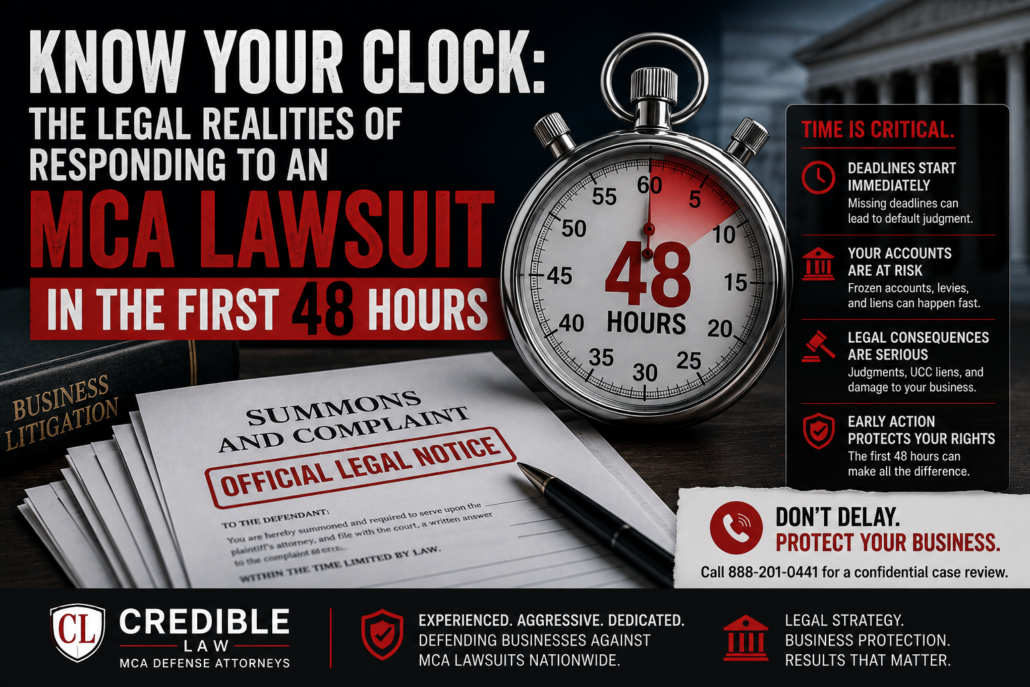
Know Your Clock: The Legal Realities of Responding to an MCA Lawsuit in the First 48 Hours
Business owners tend to learn about merchant cash advance litigation the hard way — after it has already begun. By then, the questions come in a rush. How long do I have to respond? Why was I sued in a state I have never set foot in? Can they really freeze my account? Is it too late to fight? Each of these has an answer grounded in how the legal process actually works, and understanding those answers in the first 48 hours is what allows a business owner to respond from knowledge rather than fear.
This is a walk through the legal realities of that window — not as scare tactics, but as the practical map every served business owner deserves to have.
MCA Lawsuit Defense
Just been served? Your response deadline is already running.
The date printed on your summons controls — not the funder, and not anything you’re told over the phone. Before that clock runs out, it’s worth confirming which court you’re in, whether the papers are a summons or an arbitration demand, and whether you were named personally as well as your business. Credible Law connects business owners with attorneys who defend merchant cash advance cases and can review the papers with you.
Credible Law is a national legal resource and referral network. It is not a law firm and does not provide legal advice or legal services.
Reality one: a lawsuit starts a deadline, not a seizure
The most common and costly misunderstanding is the belief that being sued means the account is about to be emptied. In the ordinary case, that is not how it works. A lawsuit is the commencement of a legal action, and it triggers a defined period during which you must respond. It does not, by itself, authorize the funder to touch your accounts.
To reach your money, a funder generally must first obtain a judgment, and then enforce that judgment through a restraining notice or levy served on your bank. Those are distinct legal steps, and each takes time and creates an opportunity to intervene. So on the day you are served, the immediate legal reality is usually a running deadline — not an imminent freeze.
The significant exception is the confession of judgment. This is a provision, often signed at the outset of the advance, in which the business owner pre-authorizes the entry of a judgment without the normal process of a lawsuit. Where one exists and is enforceable, it can dramatically shorten the path between dispute and enforcement. Because these clauses have been so heavily abused in the merchant cash advance world, some jurisdictions have restricted them — New York, for instance, curtailed their use against out-of-state debtors — but they remain a serious risk factor that has to be assessed immediately. CredibleLaw’s detailed treatment of the confession of judgment explains how these provisions operate and how they can sometimes be challenged, which is essential reading if you suspect your agreement contained one.
Reality two: the deadline is real, specific, and unforgiving
Every response deadline runs from the moment of service and is governed by the rules of the court where the case was filed. The exact length depends on the state and on how you were served. As general guidance, New York often allows around 20 days for in-state service and 30 days for service outside the state; New Jersey commonly permits 35 days; Florida frequently allows 20. But no article can tell you your deadline — only the summons in your hand can, and that printed date controls.
Missing it has a specific legal consequence: the funder can ask the court to enter a default, and then pursue a default judgment. A default judgment is not a lesser judgment. It carries the same enforcement power as one entered after a fully litigated trial, and it is frequently the mechanism by which accounts ultimately get frozen. Default judgments can sometimes be vacated, but doing so is harder, slower, and more expensive than simply responding on time. The entire legal advantage of the first 48 hours comes down to preserving that deadline.
Reality three: the distant courtroom is by design
One of the most disorienting features of merchant cash advance litigation is being sued somewhere you have no connection to. This is not a mistake. The overwhelming majority of these agreements contain a forum-selection clause naming a particular state — very often New York — as the required venue for any dispute. That clause is how a business in Texas, Colorado, or Georgia ends up defending a case in a New York court.
The legal reality is nuanced. Forum-selection clauses are generally enforceable, which means the distant filing cannot simply be ignored. But they are not always bulletproof. Depending on the circumstances, they can sometimes be challenged based on how the clause was presented, whether the chosen forum is fundamentally unreasonable, or whether it conflicts with the public policy of the business owner’s home state. That is a fact-specific analysis, and it is one reason getting knowledgeable eyes on the contract early is so valuable. What you cannot do is treat the distance as a reason to disengage.
Reality four: it might not be a lawsuit at all
Not every merchant cash advance dispute begins in a courtroom. A growing share of these agreements route disputes to private arbitration rather than public litigation, which means the document you were served with may be an arbitration demand rather than a summons and complaint. The distinction is legally significant and easy to miss in the first shock of receiving papers.
Arbitration follows different procedures, different deadlines, and different rules of engagement than court litigation. The response obligations are set by the arbitration provider’s rules and the contract itself rather than by state civil procedure, and the timeline can be just as unforgiving as a court deadline — sometimes more so. Failing to respond to an arbitration demand can lead to an award entered against you, which can then be confirmed by a court and enforced much like a judgment. So the same urgency applies, but the specific steps differ, which is exactly why identifying at the outset whether you are facing litigation or arbitration is part of the first-48-hours triage. Reading the caption and the body of the document carefully, and having counsel confirm which track you are on, prevents you from preparing for the wrong process entirely.
Reality five: you may have more defenses than you think
The framing of a merchant cash advance as a purchase of receivables rather than a loan is central to how these products avoid traditional lending regulation — and it is also where some of the strongest defenses live. Most agreements promise to reconcile payments to actual revenue through a defined holdback percentage. When a funder collects a fixed amount regardless of real sales, and especially when it refuses a legitimate reconciliation request during a genuine revenue decline, it may be asserting an unconditional right to repayment. That unconditional right is a defining characteristic of a loan.
If an advance is recharacterized as a loan, its effective interest rate becomes the central question, and many of these products carry effective rates far above lawful thresholds. That can render an agreement vulnerable in ways the funder’s aggressive filing never hinted at. The record of your payments, your revenue, and any reconciliation requests is therefore not just bookkeeping — it is potential evidence. Preserving it in the first 48 hours keeps those defenses available.
Reality six: the personal guarantee changes who is on the hook
Business owners often assume that because they operate through an LLC or corporation, only the business entity is exposed in a lawsuit. Merchant cash advance agreements frequently defeat that assumption through a personal guarantee. When you signed one — and most of these agreements include one — you agreed to be personally responsible if the business fails to pay, which means the funder can pursue you as an individual, not just your company.
Legally, this matters enormously in the first 48 hours because it expands what enforcement can reach. A judgment that includes a personal guarantor can potentially be enforced against personal bank accounts and assets, not only business accounts. It also raises the stakes of the self-help mistakes discussed above: closing an account or blocking debits in a way that triggers default can expose the guarantor personally. Understanding whether you signed a guarantee, and exactly what it covers, is therefore a core part of assessing your true exposure. It is one of the first documents your counsel will want to see, and one of the reasons a careful review of the entire agreement — not just the summons — belongs in the opening window.
The legal steps that fit in two days
Understanding the realities is the foundation; here is how they translate into action within the window.
In the first hours, document service precisely and locate the deadline. Preserve the envelope and every page, because the manner of service can itself be a legal issue. Identify the court, the docket number, and whether you were named individually as well as your business.
Within the first day, assess the account-freeze risk by determining whether your contract contained a confession of judgment, and confirm with your bank whether any legal process has actually been received. Avoid self-help measures — moving funds or blocking debits on your own can create new legal problems rather than solve existing ones.
By the second day, engage counsel who defends these specific cases. This is a genuine legal distinction: debt-settlement companies are not authorized to practice law, cannot appear before a court, and cannot file the motions that protect you during the critical early phase. Alongside that, assemble the documentary record — the agreement, guarantees, statements, and payment history — that your defense will be built on.
Responding from knowledge
The reason merchant cash advance funders win so many cases by default is not that their claims are unbeatable. It is that business owners, blindsided and uninformed, let the deadline pass and forfeit the fight before it begins. The legal process, understood clearly, is far less mysterious than it feels in the moment of service. It has defined steps, defined deadlines, and defined openings for defense.
A business owner who spends the first 48 hours learning the clock they are on, protecting the evidence, and getting the contract in front of qualified counsel has already changed the trajectory of the case. For a structured walkthrough of that window, CredibleLaw’s guide on responding to an MCA lawsuit organizes the legal realities into a sequence any served owner can follow. The papers may have arrived on the funder’s schedule, but the response belongs to you.This article is for general informational purposes and is not legal advice. Legal procedures, deadlines, and defenses vary by state, court, and the terms of each contract. Consult a qualified attorney about your specific circumstances


